How Symmetry Helps Scientists Solve Difficult Wave Equations
At the Dynamical Systems Workshop, Dr Ali Raza explained how Lie symmetries reduce complex nonlinear wave equations and reveal new solution families for applied science.
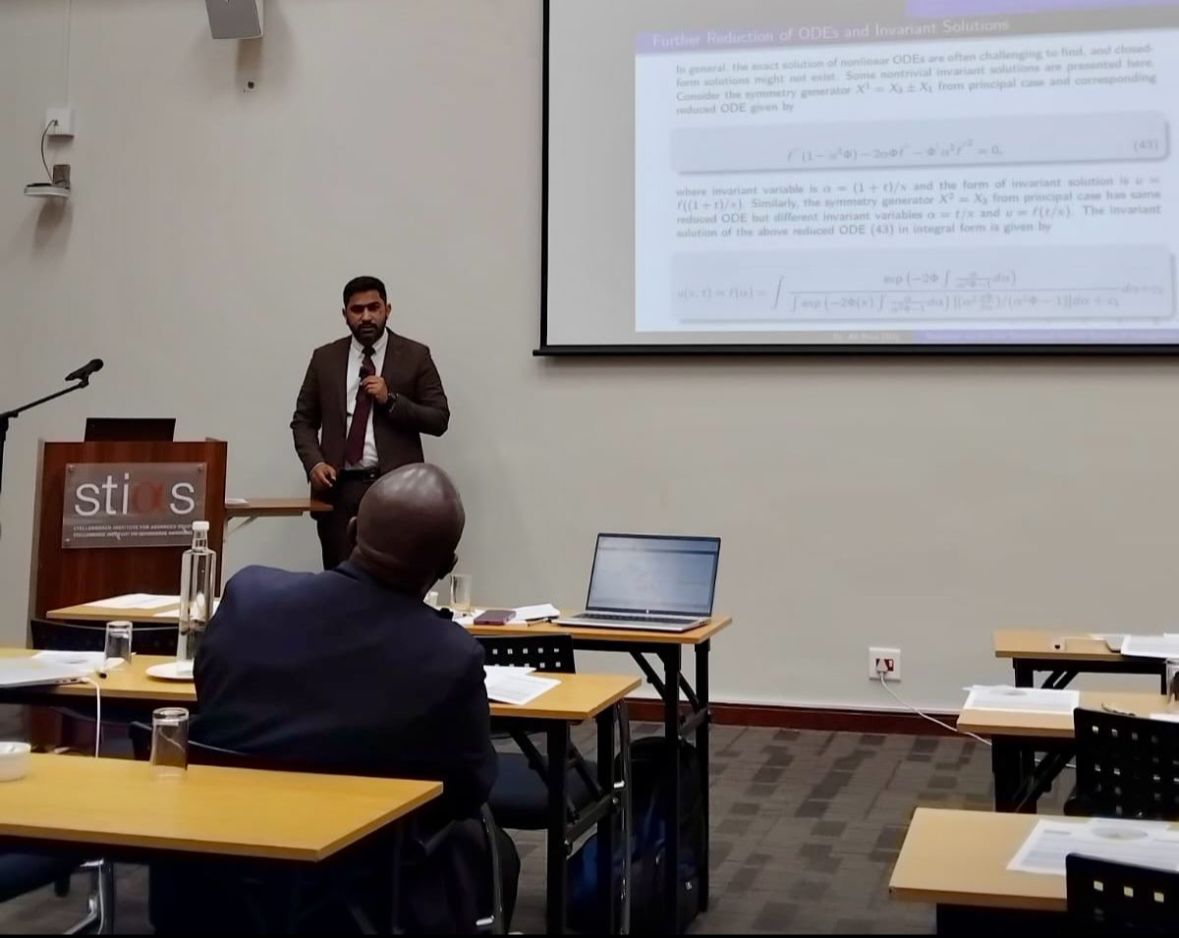
At the Dynamical Systems Workshop at Stellenbosch University, Dr Ali Raza shared how symmetry-based methods can make highly complex nonlinear wave equations more tractable.
These equations model how vibrations, signals, and energy propagate through different systems. Once nonlinearity enters the equation, standard solution techniques often break down.
The Core Idea
Dr Raza applies methods inspired by Sophus Lie’s 19th-century work: if an equation remains invariant under a transformation, that transformation can be used as a symmetry tool.
In practice, those symmetries reduce the original equation to a simpler form while preserving the underlying physical behaviour.
The “Optimal System”
A central part of his work is constructing an optimal system of symmetries, a structured set of transformations that captures a broad space of possible solutions.
These systems can uncover solution families that would otherwise remain hidden in models relevant to biomembranes, engineering, and broader wave dynamics.
Why It Matters
Dr Raza’s recent work has been accepted for publication and reflects the growing impact of symmetry-based approaches across physics and applied mathematics.
The talk highlighted an important theme at Quantum@SUN: foundational mathematics remains a key driver of innovation in modern scientific modelling.
Related Stories
All news09 Feb 2026
Inside the QWorld Annual Meeting: Connecting a Global Quantum Community
The second QWorld Annual Meeting convened participants from across continents to coordinate education, internships, and open collaboration across the QWorld network and its regiona…